
Web Design Consultation
A web design consultation is an essential step in the process of building a successful website. During this consultation, you'll work with a web design professional to discuss your website's goals, requirements, and design ideas. Here are the different facets of a web design consultation:
Schedule Your Consultation
Goal Identification
Goal identification is the most important part of a web design consultation — the foundation a successful site is built on. During this process, we work with you to understand your business, your target audience, and the purpose of your site.
Understanding your business
We'll discuss your business and what makes it different from the competition — your products, services, and audience — so we understand how your site can help you meet your goals.
Establishing the goal of your site
We'll define the goal of your website — whether that's collecting leads, selling a product or service, adding value for customers, or promoting your brand — so the design fulfills that goal.
Who is your target market?
We'll help you determine your audience — who they are, what they do, and what interests them — so we can design something that speaks directly to the people you want to reach.
Analyzing your competition
We'll analyze your competition to see what's working and what isn't, helping us create a design that differentiates your site and offers real value to your audience.
Determining key performance indicators (KPIs)
We'll help establish KPIs — like traffic, bounce rate, conversion rate, or engagement — so you can track how your site is performing and adjust as needed.
Content Strategy
We'll collaborate with you to establish a content strategy that aligns with your objectives — the types of content you'll need (text, images, video, infographics) and how it should be organized and presented.
Knowing who you're writing for
We'll help pin down your target audience's needs, desires, and thought process — the reference point for content that actually interests and informs your users.
Setting goals and objectives
We'll define clear goals for your content strategy — more visits, better engagement, more leads, or more sales — so you have a clear picture of success.
Conducting a content audit
We'll review your existing content — blog posts, product descriptions, and more — to identify gaps and opportunities.
Developing a content plan
We'll build a content plan covering what to create, who creates it, and how it will be promoted, often including a content calendar.
Writing and ranking content
We'll help develop and improve your content so it's engaging for readers and SEO-friendly for search engines.
Content performance and measurement
We'll track visitors, engagement, and other KPIs to see whether your content strategy is meeting your goals.
User Experience (UX) Design
UX is about creating a website that's user-friendly, accessible, and meets the needs of your audience — including people with disabilities.
Knowing your audience
We'll help pinpoint your ideal users and what motivates them — a critical starting point for designing an enjoyable experience.
Conducting user research
Through surveys, interviews, or usability testing, we gather feedback from your target users to find out how to improve your site.
Developing user personas
We'll help create user personas — fictional characters representing your users — to make sure your website is built for their needs and preferences.
Compiling user flows and wireframes
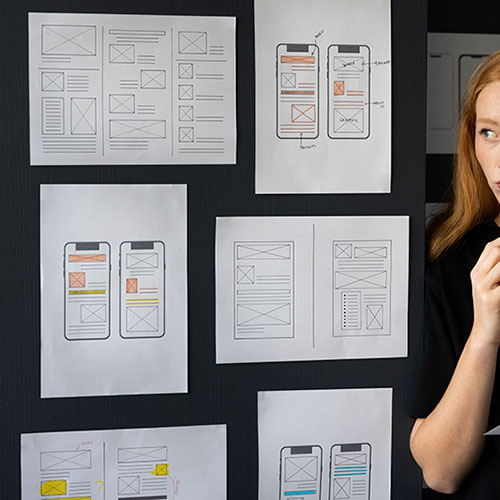
We'll map out how visitors navigate your site with user flows and wireframes, so they can find what they're looking for efficiently.
Optimizing for mobile devices
We'll make sure your site is responsive, loads quickly, and scales well across screen sizes.
Testing and iteration
We test and iterate — through usability testing, A/B testing, and more — to keep improving the experience.

Visual Design
Visual design is about creating a website that looks good, stays on-brand, and is easy to use — sharp, polished, and consistent with your content and goals.
Understanding your brand's image
We'll determine the image you want for your brand and make sure your site reflects it — color scheme, fonts, and imagery included.
Choosing the right layout
We'll guide you toward a layout that meets your business goals, keeps content easy to find, and looks great.
Incorporating visual elements
We'll help select photos, videos, and other visuals that are relevant, high-quality, and aligned with your site's content and goals.
Ensuring accessibility
We'll make sure your visual design works for people with disabilities — alt tags, video captions, and keyboard navigation included.
Optimizing for mobile devices
We'll make sure your site looks and performs well across screen sizes, since more people browse from their phones every year.
Testing and iteration
We'll test the visual design against real results, using A/B testing and other methods to identify what needs improvement.

Technical Considerations
Technical considerations make sure your website works reliably, is secure, and is indexed properly by search engines — a website is more technically complex than most businesses realize.
Choosing a hosting provider
We'll help you find a dependable host — shared, VPS, or dedicated — based on what your website needs.
Selecting a content management system (CMS)
We'll help identify a CMS that fits your needs and technical comfort level, such as WordPress, Squarespace, or Wix.
Ensuring website security
We'll implement SSL certificates, firewalls, and other protections to keep your site and your users' data safe.
Optimizing for speed
We'll optimize images, compress files, and use caching to keep your site loading fast on any device.
Accessibility and SEO
We'll make sure assistive technologies, keyboard navigation, and alt text are in place, and that your site structure supports both users and search engines.
Web standards compliance
We'll make sure your HTML, JavaScript, and CSS meet current web standards for browser and device compatibility.

Budget and Timeline
Budget and timeline are assessed during a web design consultation to make sure we can complete your project within your budget and schedule.
Project scope
We'll define your website's functionality, design, and technology needs, which helps establish both budget and schedule.
Available resources
We'll look at the time, budget, and staff you have available, and what's needed to bring the project to life.
Design complexity
We'll assess how complex the build is, since more elaborate designs typically need more time and cost.
Technical requirements
We'll factor in hosting, CMS, and security needs, since more complex technical requirements affect both cost and timeline.
Content creation
We'll estimate based on how much content needs to be created and at what quality — this affects both budget and timeline.
Testing and revisions
We'll account for the testing and revisions needed to make sure your site is fully functional before launch.
Client communication
We'll build in time for clear, ongoing communication between you and our team throughout the project.
Ready to Plan Your Website?
Let's schedule a consultation and map out your project together.
Get a Free Consultation